
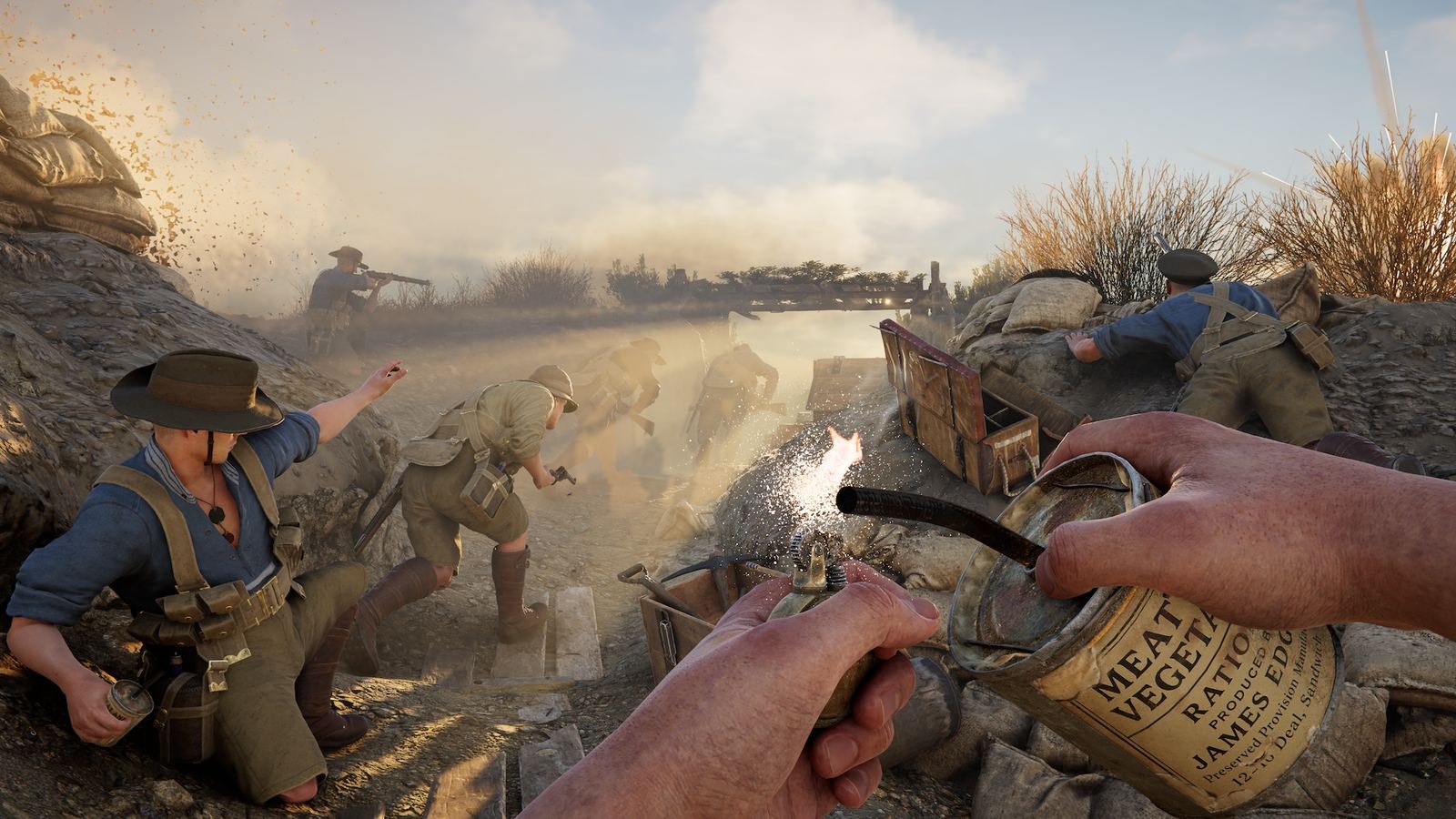

Gunplay is one of the areas BlackMill worked on the most for Gallipoli: stamina, reloading, suppression, ballistics and damage were nearly rewritten from scratch compared to Isonzo. Here’s how it all works, so you know what actually changes when you’re shooting or being shot at.
Stamina and sprinting
Stamina matters more than before: sprinting, meleeing, jumping and vaulting all drain it. But the system is also more forgiving: you’re never locked out of an action just because you’re exhausted. Movement gets less rigid, your aim sways more and you sprint slower, but you can still get the job done.
Your maximum stamina depends on your health state: the more hurt you are, the lower the cap gets, down to about half if you’re downed (more on that below). Regeneration speed depends on your loadout: heavy weapons like the Lewis Gun slow it down a lot, while carrying just a sidearm gets you back on your feet in a jiffy.
If your stamina is nearly full you’ll sprint faster; draining it through sprinting or a brawl slowly costs you speed. Even at zero stamina you can keep running, just slower. A sip from your water flask gives a temporary speed boost.
Crouched sprinting: starting a sprint from crouched no longer stands you up automatically. You stay low and fast at once, useful for keeping your head down in a trench, but it drains stamina faster and runs a touch slower than a regular sprint.
Proned “sprinting”: you can also “sprint” while prone to get out of a tight spot while staying as low as possible, at the cost of a lot of stamina. Handy while suppressed.
Reloading and weapon handling
Every weapon has unique reload animations split into three stages: unloading, reloading, closing the bolt. For single-round weapons like rifles, every round inserted counts as its own stage. Completing a stage acts as a checkpoint: get interrupted, and you won’t lose a round you already loaded.
Two handling systems new compared to Isonzo:
- Drag: how quickly your weapon follows your movement, based on its weight. Light weapons like pistols respond almost instantly when turning, aiming down sights or ending a sprint; heavy weapons like machine guns take longer. Modifications (bayonet, scope) add weight and slow the response.
- Sway: aim wobble has been reworked. Beyond the classic “breathing” pattern, there’s now “hand wobble” (light weapons) and “arm fatigue” (heavy weapons); holding your breath drastically reduces all of it, but only for a limited time.
- Surface resting: you can now rest any weapon on any surface, not just bipod-equipped ones: useful from behind cover or prone. Bipods are still stronger, but you have to deploy them.
Suppression: more than a visual effect
In Isonzo, suppression was mostly a visual effect. In Gallipoli it triggers your fight-or-flight instinct: sway and recoil increase first, then panic kicks in. Vision darkens and loses color, your hands shake making it hard to aim and fire, and near misses make you flinch. Heavy suppression can make closing the bolt (the last reload stage) take a second longer, but it’s not a jamming mechanic: the reload always succeeds.
Machine guns suppress best thanks to volume of fire; bullet suppression is stronger at long range (a single near-miss up close won’t shake you as much). Explosions suppress based on their power, and grenades designed to stun suppress relatively more. The best counter is going prone, ideally behind cover: it partially resists the effects and speeds up recovery.
Ballistics: no more hitscan
Bullets now take time to travel over long distances and drop along the way depending on the weapon and round. It’s barely noticeable within a weapon’s intended range, very noticeable if you try to snipe with a revolver.
Damage fall-off: depends on the weapon. Small arms like pistols start losing damage after 10 meters, rifles between 50 and 100 meters. Regardless of range, a headshot always kills in one hit.
Body zones: beyond head/arms/body, damage now also accounts for neck, belly, pelvis, upper and lower limbs, hands and feet, each with its own multiplier.
Penetration: materials genuinely affect bullets passing through. Fabric barely slows them, a wooden pole a lot more, and the harder the material, the more stopping power a bullet loses coming out the other side (if any remains). Using your squadmates as a human shield is not recommended.
Damage, travel time, drop and penetration: all calculated from muzzle velocity, bullet weight, diameter and nose shape. You don’t need to memorize every weapon, stats are comparable in-game.
The Downed State
A non-immediately-lethal hit, say a shot to the thigh from range, won’t kill you outright: you go down, bleeding out, and nearby allies can bandage you and get you back into the fight severely wounded.
While downed you have two options: lie still to slow the bleeding and give allies time to reach you, or crawl to a safer spot. Crawling speeds up the bleeding, though. You can’t draw a weapon or melee: any further damage, or bleeding out, finishes you off (crediting the kill to whoever downed you).
When you’re downed instead of killed: centermass within a weapon’s intended range, a close-range shot, a headshot or melee always kill outright without downing. You’re more likely to be downed if hit outside a weapon’s effective range, or in the arms/legs from medium range onward. Explosions can down you if you’re just outside their lethal radius but close enough to take considerable damage.
In practice: good positioning near your squad gives you a second chance if you’re just grazed; caught alone in the open, going down still leaves you an easy target to finish off.

Summary
- Stamina: drains faster, but never locks you out: it just slows you down and adds sway.
- Reloading: staged with checkpoints. Getting interrupted is never a total loss.
- Suppression: hits vision, aim and reload, but going prone behind cover speeds up recovery.
- Ballistics: real drop and travel time, per-body-part damage, material penetration.
- Downed: a second chance with your squad nearby, a real risk if you’re alone.
Source: official devblogs “Gallipoli - Movement Improvements”, “Gallipoli - Major Improvements to Gun Play”, “Gallipoli - Ballistics & Damage” and “Gallipoli - The Downed State”, BlackMill Games. Numbers and details may change compared to what’s shown here, before and after launch.